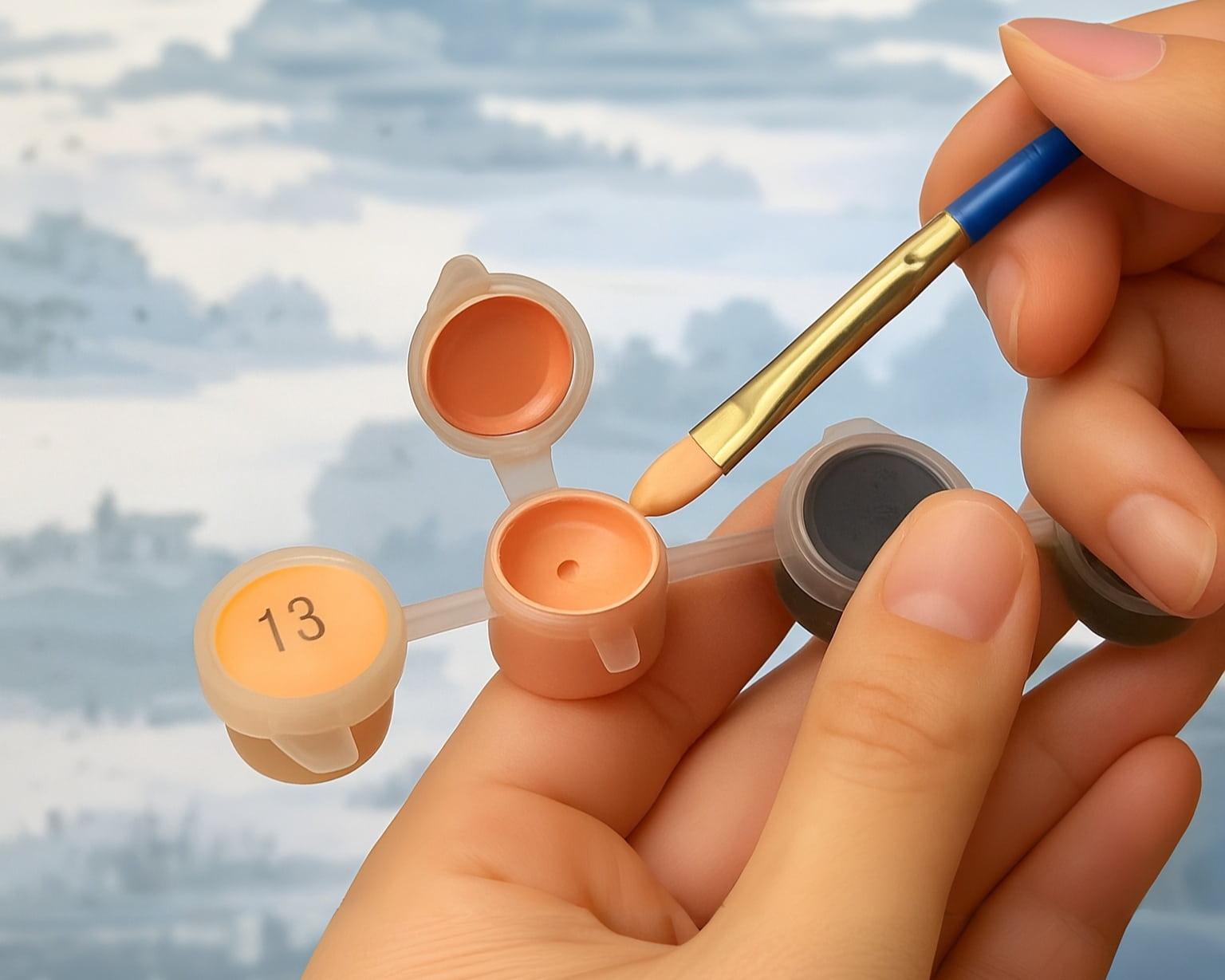
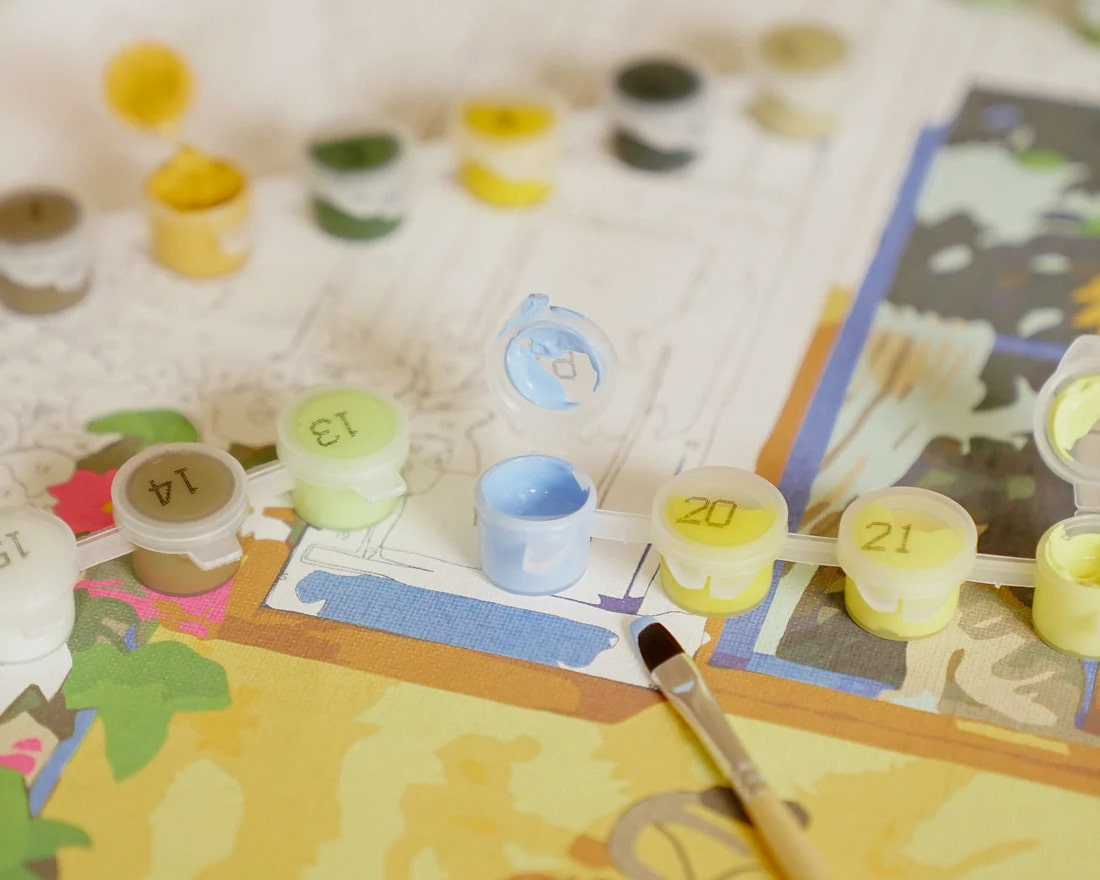
When people say paint by numbers helps them relax, they often describe it as “easy” or “simple.”
But the real reason it feels calming isn’t simplicity — it’s relief.
Relief from decision-making.
Relief from self-correction.
Relief from the constant feeling that you should be doing things better.
Paint by numbers is structured, yes — but what it really offers is a rare kind of mental space: a creative activity where your brain doesn’t have to hold the burden of choice.
1) The Brain Doesn’t Rest When It’s Still Deciding
Modern stress isn’t always emotional. Often it’s cognitive.
Even during downtime, many people stay mentally “on”:
planning, replaying conversations, anticipating tasks, running through what-ifs. The body might be sitting still, but the mind is still working.
That ongoing background work is powered by the same system we rely on for making choices and staying organised — what psychologists often call executive function (the part of the mind responsible for planning, prioritising, and self-monitoring).
This is why some people find it hard to relax with activities that are open-ended. A blank canvas looks peaceful, but it also asks a question that keeps executive function switched on:
What should I do next?
Paint by numbers answers that question for you.

2) Paint by Numbers Reduces “Decision Load” — and That’s a Big Deal
The easiest way to understand its stress-relief effect is through decision load: the number of small decisions your brain has to carry at once.
In free painting, you’re constantly deciding:
- colour selection
- where to begin
- whether something looks balanced
- whether the shading makes sense
- whether you should fix a section you’re unhappy with
None of those decisions are “big” on their own. But together, they create friction — especially for beginners or anyone already mentally exhausted.
Paint by numbers removes most of that decision load.
You still get to paint, but you don’t have to keep running a parallel mental process of planning and judging.
That’s not a small difference. It’s the difference between an activity that drains you and one that refuels you.
3) It Also Reduces Self-Monitoring — the Quiet Source of Pressure
There’s another mental process that makes relaxing difficult: self-monitoring.
Self-monitoring is the part of the mind that constantly checks:
Am I doing this right?
Is this good enough?
Should I be faster, better, more creative?
For many people, self-monitoring doesn’t turn off easily — especially if they’re perfectionistic, high-achieving, or used to being evaluated.
Paint by numbers naturally softens self-monitoring because the task isn’t about originality. It’s about completion.
You’re not proving artistic talent.
You’re not inventing from scratch.
You’re simply following a clear system.
That gives your nervous system something it rarely gets in daily life: permission to be “good enough” by design.
4) Why “Small Completion” Feels Calming (and Addictive in a Good Way)
Paint by numbers provides something psychologically satisfying: frequent micro-completion.
Every filled section becomes a completed unit.
Not a vague “I made progress,” but a visible, finished piece of work.

That matters because the brain responds strongly to clear completion cues. In modern life, so many tasks never truly end — inboxes refill, feeds keep scrolling, responsibilities reset daily.
A paint-by-numbers canvas is different. It has edges. It has steps. It has an end.
And within that structure, you get steady signals of progress — which can reduce mental noise and restore a sense of control.
5) How to Use This as a Stress-Relief Tool (Without Making It Another “Task”)
The key is to use paint by numbers in a way that protects the feeling of no-pressure structure.
Try these simple adjustments:
Pick one “low-stakes” area of the canvas.
Choose a section that isn’t visually central (background, sky, soft gradients). Starting there reinforces the message: this doesn’t need to be perfect.
Treat numbers as instructions, not performance.
The value of the activity isn’t your accuracy — it’s the fact that you’re letting your mind follow something clear.
Stop mid-section on purpose once.
This sounds strange, but it trains your brain to stop tying relaxation to completion. You can pause and still feel calm — the canvas will wait.
These are small shifts, but they preserve what makes paint by numbers powerful: low decision load, low self-monitoring, steady progress.
A Quiet Form of Relief
Paint by numbers isn’t relaxing because it’s “easy.”
It’s relaxing because it removes the mental weight we carry all day: choice, judgement, correction, and performance.
It gives your hands something to do and your mind something it can trust — a clear path, one section at a time.
And in a world that asks you to decide constantly, following numbers can feel like a small, generous kind of freedom.